Wednesday, February 23, 2022

No, the First M16 Maintenance Manual Was Not a Comic Book

No, The First M16 Maintenance Manual Was Not A Comic Book. 

Copyright 2022 by Michael H. Maggelet

  Despite claims appearing on several websites ("The Original M16 Manual Was a Vietnam War Comic Book"), the first maintenance manual for the M-16 was not a comic book.    The Colt Model 01 (Model 601) was tested during Project Agile in Vietnam in 1962, and gave excellent performance with South Vietnamese Special Forces, ARVN Ranger units, and US advisors.  Several reports stated that the .223 Remington round produced horrendous wounds on Viet Cong troops, later disproven. These forces also tested the Energa rifle grenade with the Model 601 with excellent results. 
 These troops gave excellent marks to the select fire AR-15 for its handling, with Colt noting the troops kept the rifles clean. Such was not the case in later years, with many older, worn out early M16 rifles without chrome plating in the chamber or barrel still in theater. It should be noted that the military issue Colt AR-15/M16 was a select fire weapon, while the commercial Colt AR-15 SP1 Sporter (Model 6000 and subsequent versions) was a civilian legal single shot rifle with parts in the fire control group and a lower receiver that were not interchangeable with the full automatic version. It was first offered for commercial sale in 1964 for $189.50 (about $1690.76 in 2021 dollars). 
  
  Regardless, General Curtis LeMay finally succeeded in ordering 19,000 AR-15 rifles in 1962, which were supplied to U.S. Air Force units worldwide to replace worn out M-1 and M-2 Carbines (the USAF was still using WWII era small arms). Navy SEAL teams also obtained around 100 rifles when they were first formed in 1962. 

  Early USAF maintenance manuals included Technical Order 11W3-5-5-1 dated February 1960, and Air Force Manual 50-12 dated August 1963.

  The procurement of the M16 was finalized on 4 November 1963 when SECDEF signed Contract 508 for 104,000 XM-16E1's with the forward assist (for the Army), and 19,000 M16's (for the USAF). 
The maintenance manual was produced for all the services by at least 15 June 1964 under Army TM 9-1005-249-14, USAF TO 11W3-5-5-1, and NAVWEP O.P. 3333.  

  In our armory in West Germany during the late '80's, we had a good quantity of Model 601's (with black painted furniture), in addition to 602's and 604's. 


             Screenshot of TM 9-1005-249-14 dated 15 June 1964 (source- AR15.com website). 


  The maintenance manual for the XM-16E1 was US Army Technical Manual 23-9, dated  January 1965, and the "M16A1" nomenclature was officially adopted by 28 February 1967 as noted in Army correspondance (it is referred to as the M16 in previous ordnance correspondance).   In August 1967, a playing card sized "maintenance card" GTA 21-1-3 was issued. 
  It wasn't until June 1968 that the "comic book" style Army pamphlet 750-30 was issued. We had the Air Force technical manual for the M16 in our armory, along with several copies of Army pamphlet 750-30.

  For a detailed history on the development of the M16 rifle, I'd recommend "The Black Rifle- M16 Retrospective" by R. Blake Stevens and Edward Clinton Ezell, along with tons of historical documentation on the "Small Arms Review" website and the "AR15.com" forum.  

Timeline of Maintenance Manual issuance-
February 1960- USAF TO 11W3-5-5-1.
August 1963- AFM 50-12.
15 June 1964- XM16E1 and M16 maintenance manual under Army TM 9-1005-249-14, USAF TO 11W3-5-5-1, and NAVWEP O.P. 3333.
January 1965- TM 23-9. 
August 1967- Maintenance card GTA 21-1-3 issued. 
February 1968- Change 1 to FM 23-9. 
June 1968- Army pamphlet 750-30 "comic book" issued. 
Additional reading-

"The Black Rifle- M16 Retrospective" by R. Blake Stevens and Edward Clinton Ezell. Collector Grade Publications, 1992. May be out of print. 

AR15.com forum archives. 

Interview with Eugene Stoner by Edward Clinton Ezell on the development of the M16 rifle-

https://www.youtube.com/watch?v=kaIU0nCxwGg

The Coconut Rifle
https://smallarmsreview.com/display.article.cfm?idarticles=254


Like
Comment
Share

No US Nuclear Missiles in Europe, Vladimir.

No US Nuclear Missiles in Europe, Vladimir.

Copyright 2022 by Michael H. Maggelet

  One outlandish claim circulating in Russian state media and among its Western lackeys are statements that the US and NATO have “missiles in Europe that can hit Moscow in minutes”. Seriously?


  During the 1990’s, I was one of several USAF enlisted liaison’s working with the US Army during Operation Silent Echo from 1990 to 1992. The US Army withdrew all of its tactical nuclear weapons from NATO during that time, and retired and dismantled all of the nuclear warheads. The only nuclear deterrent remaining in USAFE are air delivered bombs (
declassified per DOE Office of Classification, WNP-137, 24 March 2011).


  However, Kremlin apologists and Putin’s western lapdogs continue to claim that “US missiles” in eastern Europe are capable of hitting Moscow. This is not true, since the only missile systems deployed in Poland and Romania are short range SM-2 and THAAD anti-ballistic missiles, etc., with conventional warheads. Of course, Comrade Putin is well aware of the capabilities and order of battle of every NATO country via open sources and GRU espionage, but he chooses to ignore the facts when pushing his Chekist/KGB vision of a Nazi style “anschluss” (going so far as to proclaim that the president of Ukraine 
Volodymyr Zelenskyy, who has Jewish ancestry) and his countrymen are "nazi's". 

 In 2008, Russian president Dmitry Medvedev announced the deployment to Kaliningrad of Iskander surface to surface missiles, in response to the US ballistic missile defense program (while conveniently ignoring their own tactical and strategic ABM capabilities). 

  Russian forces currently have approximately 1800 tactical nuclear weapons to include surface to surface rockets, short range ballistic missiles, ground launched cruise missiles, tactical nuclear bombs, nuclear depth bombs, nuclear torpedoes, nuclear armed anti-submarine rockets, surface to air missiles, and air to surface missiles operationally deployed on Russian soil, in Kaliningrad, and on warships in the Northern and Pacific fleets (the US has no nuclear weapons on surface ships).

  What Vladimir Putin has guaranteed is a future re-deployment of US tactical nuclear weapons systems to NATO.


Suggested reading-

"NATO Says Russian Missile Deployment Threatens Arms-Control Efforts" by Ahto Lobjakas, 6 November 2008. Radio Free Europe/Radio Liberty

https://www.rferl.org/a/NATO_Says_Russian_Missile_Deployment_Threatens_ArmsControl_Efforts/1339015.html


Missile Defense Agency countries, radars, systems, and deployment-


https://mda.mil/system/international_cooperation.html


Background information on BMD systems-

https://missiledefenseadvocacy.org/system_type/intercept-missile-defense/


"Russia’s Nuclear Weapons: Doctrine, Forces, and Modernization" Updated January 2, 2020 by Congressional Research Service. Links to pdf.

https://s3.documentcloud.org/documents/6598970/Russia-s-Nuclear-Weapons-Doctrine-Forces-and.pdf


Saturday, July 17, 2021

Facts Check Please. "National Interest" Gets It Wrong.

Facts Check Please. "National Interest" Gets It Wrong.

Copyright 2021 by Michael H. Maggelet


A recent article in the "National Interest" website entitled "Missing in Action: Six of America's Nuclear Weapons Are Unaccounted For" (April 18, 2021) is rife with errors. Not surprisingly, the article has been copied and the disinformation spread on the web on various websites. 

Let's take a look at some of the claims versus the facts. Many of the claims are partially extracted from the 1977 and 1980 DOD accident list, with some disinformation thrown in by the "Center for Defense Information" and others over the decades.

Claim- "February 13, 1950- The longest missing nuclear weapon hasn't been seen in 71 years, and it is unlikely it will be found anytime soon.

It was lost when the crew of a United States Air Force Convair B-36 bomber was conducting a mock nuclear strike and was en route from Eielson Air Force Base (AFB), Alaska to Carswell AFB, Texas, when it developed engine trouble. Not wanting to have a crash with a nuclear warhead, the crew was ordered to drop its 30-kiloton Mark 4 (Fat Man) bomb into the Pacific Ocean.

According to the "official" report, the bomb didn't contain the plutonium core necessary for a nuclear detonation, but it still contained a substantial amount of uranium."

Facts-
In the case of the February 13, 1950 accident, the Mk 4 bomb was intentionally jettisoned due to an in-flight emergency, and set for an airburst. The aircraft did not have a nuclear capsule on board, and only a lead (Pb) training capsule was installed in the bomb. Only the bomb's high explosive content detonated (a nuclear detonation was not possible), and the depleted uranium content could not produce any nuclear detonation (and was vaporized in the HE detonation).

- - -

Claim- "March 10, 1956- Six years after losing the first bomb, two nuclear cores were lost when a B-47 bomber likely crashed in the Mediterranean Sea while en route from MacDill AFB, Florida to Ben Guerir Air Base, Morocco. The aircraft had successfully completed its first aerial refueling, but it failed to make contact with a tanker for a second refueling and was reported missing. 

The exact weapon wasn't disclosed, but the B-47 typically carried the 3,400-kilogram Mark 15 nuclear bomb. No trace of the plane nor the cores has ever been found."


Facts- There was no nuclear bomb aboard the aircraft, only two capsules of nuclear material stored in "birdcages". This information is rather evident if one actually bothers to read the official DOD narratives-

March 10, 1956 / B-47 / Mediterranean Sea

The aircraft was one of a flight of four scheduled for non-stop deployment from MacDill AFB to an overseas air base. Take-off from MacDill and first re-fueling were normal. The second refueling point was over the Mediterranean Sea. In preparation for this, the flight penetrated solid cloud formation to descend to the refueling level of 14,000 feet. Base of the clouds was 14,500 feet and visibility was poor. The aircraft, carrying two nuclear capsules in carrying cases, never made contact with the tanker.

An extensive search failed to locate any traces of the missing aircraft or crew. No weapons were aboard the aircraft, only two capsules of nuclear weapons material in carrying cases. A nuclear detonation was not possible.

- - -

Claim- "February 5, 1958- During a simulated combat mission near Savannah, Georgia, another Air Force B-47 bomber carrying a Mk 15 weapon collided with an F-86. After multiple attempts to land, the bomber crew was given the green light to jettison the bomb to reduce weight, and also to ensure it wouldn't explode during an emergency landing. The bomb, which was dropped over the Wassaw Sound near the mouth of the Savannah River, wasn't recovered."


Facts- In actuality, an F-86 collided with the B-47. The Mk 15 Mod 0 bomb aboard the B-47 did not contain a nuclear capsule, and a lead training capsule was stored in the cockpit (nor could it be installed into the bomb unless downloaded from the aircraft). The aircrew did not attempt to land with the bomb aboard, it was intentionally jettisoned before landing.
The bomb was jettisoned off Wassaw Sound and has not been recovered. It cannot explode in a nuclear manner since it does not contain a nuclear capsule for the primary.

- - -

Claim- "January 24, 1961- Somewhere near Goldsboro, North Carolina, a uranium core is likely buried in a field. It had been one of the cores for a pair of 24-megaton nuclear bombs that were on a B-52 that crashed shortly after takeoff. What is especially unsettling about this incident is that three of the four arming mechanisms on the bomb that was recovered had been activated.

The second bomb's tail was discovered 20 feet below ground in the muddy field, and when efforts to find the core failed to uncover it, the military did the next best thing. The United States Army Corps of Engineers purchased a 400-foot circular easement over the buried components to restrict digging."


Facts- There is no "uranium core" buried in any field in North Carolina. What is missing was the secondary from bomb two, which contains uranium (detailed in the 1977 DOD "Narrative Summaries of Accidents Involving US Nuclear Weapons, 1950-1980"). 

The bomb yields were not 24 megatons, they were approximately 3.8 megatons each, and due to safety mechanisms (two electrical ready/safe switches in each weapon), they were not pre-armed nor armed, and they could not have produced a nuclear detonation under the circumstances. 

- - -

Claim- December 5, 1965- "Somehow an A-4E Skyhawk attack aircraft, loaded with a one-megaton thermonuclear weapon, managed to roll off the deck of the USS Ticonderoga and fell into the Pacific Ocean. The pilot, plane and bomb quickly sank in 16,000 feet of water and were never seen again. 

However, it wasn't until 15 years later that the U.S. Navy even admitted the accident had taken place, and only noted it happened 500 miles from land. However, that wasn't true – as the carrier was about 80 miles from Japan's Ryuki island chain. As a result of that accident, the Japanese government now prohibits the United States from bringing nuclear weapons into its territory."

Facts- The A-4 did roll off the deck of the USS Ticonderoga, incidentally after crewmen attempted to stop it with chocks. The accident was acknowledged in the 1977 DOD "Narrative Summaries of Nuclear Weapons Accidents". The locations of many overseas accidents were classified due to agreements with the host nation, and to prevent retrieval by hostile nations. 

- - -

Claim- "Spring 1968- The final bomb to be lost and not recovered occurred sometime in the first half of 1968, and involved the loss of the U.S. Navy's nuclear attack submarine USS Scorpion, which sank about 400 miles to the southwest of the Azores Islands. In addition to the tragic loss of the 99 crewmembers, the submarine was carrying a pair of nuclear-tipped weapons, which had yields of up to 250 kilotons.

While this should be as scary as suggested, the good news is that in the past 50 plus years, no other nuclear weapons have been lost – at least that we know of."

Facts- The USS Scorpion was carrying two Mk 45 ASTOR torpedoes with W34 Mod 3 nuclear warheads. While the yield remains classified, it certainly was not 250 kilotons. There is no evidence that the sub was sunk by any torpedo or hostile action, and the two nuclear armed torpedoes remain inside the sub's hull.
The author ignores the loss of Soviet nuclear weapons on submarines in various accidents, not to mention the grounding of a nuclear armed Soviet sub in Swedish waters in 1981.

For more information on the facts surrounding US and Soviet nuclear weapon incidents and accidents, please purchase the books by Michael H. Maggelet and the late James Oskins.


Monday, May 24, 2021

Atomic Demolition Munitions- Fact versus Fiction

Atomic Demolition Munitions- Fact versus Fiction

Copyright 2021 by Michael H. Maggelet

 One of the interesting aspects of nuclear weapons development was the pursuit of small diameter man portable atomic demolition munitions. Several ADM's were fielded by the US at overseas locations in case of overrun by the Warsaw Pact or communist forces, to be issued to ADM teams to destroy tactical objectives prior to the arrival of invading enemy forces. Some special operations forces were also trained to use ADM's for missions behind enemy lines.   
  As technology improved, smaller nuclear weapons were fielded to include the gun type T4 and the implosion Mk 54 Mod 0, 1, and 2 Special Atomic Demolition Munition. The Soviet Union also fielded a number of ADM's, and many rumors surrounding these weapons are still on the web, with claims of missing weapons, or those that may have been pre-positioned in European or US caches by KGB or GRU Spetsnaz teams. A 1987 movie starring Michael Caine and Pierce Brosnan entitled "The Fourth Protocol" dealt with a KGB team emplacing an ADM near a US airbase in the UK. 
  The earliest US man portable ADM was the T4 gun type, which consisted of four separate components each weighing 40 pounds, based off the Mk 9 shell. [1]   No photograph has been publicly declassified or released of the T4, which would be rather interesting. 


US Army ADM squad with T-4 components, and UDT/SEAL with B54 SADM

(Photos Los Alamos Scientific Laboratory, and US Navy)


  The next man portable ADM was the Mk 54 Mod 0 SADM, which was fielded in April 1963, with mods 1 and 2 in use until the early 1980's. They were intended to be issued to US Army ADM platoons, Army Rangers, Special Forces, and Navy UDT and SEAL teams. There were some interesting procedures required for safing the SADM, or for its emergency destruction. A declassified film on the SADM from Sandia National Labs is linked below, and covers the SADM in very good detail. 

Photos from author's briefing on Warsaw Pact Special Operations Forces

  In 1992, KGB archivist Vasili Mitrokhin defected to the West and brought along details of KGB operations, agents, and caches of weapons, radios, and large sums of money buried in the US and Western Europe. It has been suggested that the USSR may have buried several ADM's, however there are some technical aspects as to why such weapons would not be functional after several decades of unattended storage (and the fact that these caches were boobytrapped). There is no evidence of the USSR burying ADM's in NATO countries, nor has any ADM been used in terrorist attacks. 
  Yield of the US B54 SADM reportedly ranged from ten tons up to 1 kiloton, the Soviet ADM from 800 tons to 2 kilotons (see "Spetsnaz- The Inside Story of the Soviet Special Forces" by Viktor Suvorov). 

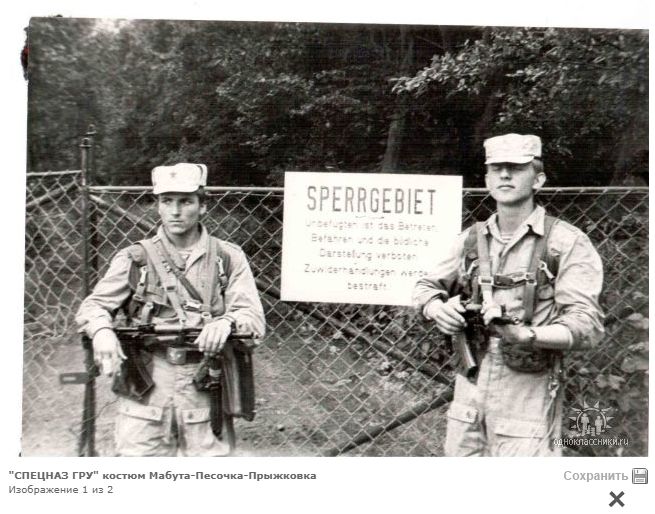
  GRU Spetsnaz troops wearing "Mabuta" uniforms training in East Germany.
 "Sperrgebiet" in German means "Restricted Area"


  One limitation of long term emplacement of an ADM is that an implosion weapon similar to the W54 SADM would require some preparation and testing before use (such as a continuity test, inspection of the ADM, and inspection of some components such as an explosive plane wave generator, timers, or radio receiver). A gun type weapon would present more problems, due to uranium spalling of the target and projectile, and age of the initiator. While some Soviet cache discoveries have been made public, some items were in pristine condition (such as the R-394KM radio recovered near Morschenich, Germany in August 2019, about 9 km- six miles- NW of a NATO air base). Some components age and the reliability of the munition after decades in the ground would be questionable. GRU Spetsnaz teams of the Army and Navy trained with atomic demolition munitions, as shown in public statements by Russian veterans. 


Map showing location of Soviet cache discovered in 2019, northwest of Norvenich, Germany


 As for statements that there are "suitcase nukes" on the loose, any gun type weapon requires periodic replacement of its neutron initiators (some US weapons required replacement every six months). Additionally some have stated that plutonium is used in gun assembled weapons, this is not true since plutonium is unsuitable for gun assembled weapons due to pre-initiation concerns.
  While US ADM's have been retired and dismantled, there is some evidence that the Russian Federation may retain some ADM's (and it's not beyond the scientific capabilities of the People's Republic of China or any nuclear weapons state, to include the DPRK). With the advent of precision guided munitions, US ADM's have pretty much been relegated to history. 

1. "History of the Mk 54 Weapon" by Sandia Corporation. Declassified from "Secret Restricted Data", February 1968. 

2. B54 SADM film overview-

Special Atomic Demolition Munition SADM - YouTube


3. "Warsaw Pact Special Operations Forces (USSR/East Germany) and USAFE Operations (1980's-1990's)" by Michael H. Maggelet, Unclassified briefing, May 2021. Presented to the USAF Special Operations School, Language and Culture Center, Hurlburt Field, Florida. 

Thursday, April 1, 2021

New Air Force Ammo Career Field Uniform Changes


Air Force to Redesign “Ammo” Badge
AIR FORCE TIMES (1 April 2021)-
The Air Force announced today that it will redesign the new Munitions Badge after many complaints from active duty and reserve personnel who were offended by the “shell and flame”, commonly referred to as a “piss pot”.

  Major Karen McKaren, head of the Air Force Equal Opportunity Office Anti-Triggering Field Training Detachment, Public Affairs Officer, and Political Officer, stated “After numerous complaints, Air Force leadership decided that the Munitions Badge was indeed offensive to a very small but vocal group of airmen in office jobs, many of whom have never deployed, worn MOPP gear, nor held an M4 carbine on duty.”
  The Air Force also announced that in honor of General Tony McPeak, the USAF will once again redesign rank insignia, add more ribbons, change the names of regulations and technical orders, and introduce new uniforms. One reason for the redesign of career field insignia, according to Major McKaren, was the fact that “No one can distinguish what anyone's career field badge is anyway, due to the blinding chrome finish."


Major Karen McKaren of Air Force’s Equal Opportunity Office Anti-Triggering Field Training Detachment, Public Affairs Officer, and Political Officer.


Old offensive Munitions Badge


New rehabilitated Munitions Badge


Air Force to Adopt Naval Work Uniform
(Military Times- Washington, DC- 1 April 2021)

 HILL AFB, UTAH- The Air Force announced today that it will adopt the recently replaced US Navy blue "Naval Work Uniform", otherwise known as “blueberry’s” for its elite Ammo airmen.

  “We’ve decided that replacing the current Air Force OCP uniform was in the best interest of our airmen, who deserve the best” stated Colonel Vason Jattioni, lead project officer. The new uniforms will be effective 1 October 2021 for AFSC 2W0X1, Munitions System Specialist. 

  The Navy NWU will be known as the AF BBU, and will have small “IYAAYAS!” logos printed on it. Colonel Jattioni also stated “If you look hard enough, you may also see some cool little “VH” logo’s, to commemorate the rock band Van Halen (not Van Hagar).”


Colonel Vason Jattioni, project lead for new Air Force "BBU" uniform.


Old Navy uniform with changes will be new Air Force BBU for elite Ammo Airmen


Monday, March 22, 2021

Commentary on "To The Stars Academy" and UAP/UFO Documentation

Commentary on "To The Stars Academy" and UAP/UFO Documentation

Copyright 2021 by Michael H. Maggelet

An introductory post on the “To the Stars Academy” website regarding the GIMBAL and FLIR 1 UAP videos states “Presented here is the first official evidence released by the US government that can be rightfully designated as credible, authentic confirmation that unidentified aerial phenomena (UAP) are real.” [1]

  I have to disagree. Declassified government files, along with reports from military witnesses and commercial pilots (along with radar data, photographs, etc) going back nearly 80 years proves beyond a reasonable doubt as to the veracity of the existence of unidentified aerial phenomena (more commonly referred to as UFO’s).

  One of the first revelations concerns the 23 September 1947 letter by General Nathan Twining to
Brigadier General George Schulgen, in which he wrote of the existence of flying discs and their performance characteristics (see my article on this blog of 30 April 2020).
  Additionally, the USAF and other government agencies spent considerable time and effort in researching and compiling information (in fact, for the past 74 years) into something that “does not exist”. Much the same can be said for the purported detention by military authorities of New Mexico rancher Mac Brazel in July 1947 for a supposed “top secret weather balloon”.
  That's not to say I disagree wholeheartedly with the "To The Stars Academy", in fact they are doing an excellent job in bringing information to light.  

 
  Interestingly enough, the Computer UFO Network submitted an FOIA request in 1996 for records pertaining to the “Interplanetary Phenomena Unit”, which was supposedly created after the Los Angeles “air raid scare” of February 1942. The reply to CUFON’s request stated all records of the IPU were forwarded to USAF Office of Special Investigations and Project Blue Book when the IPU was closed in the late '50's [2]. 

  In the end, don’t expect much of a government revelation come June 2021 on any particular UFO case. There is much, much more to the story than simply flying saucers; the question is, can the public handle the disclosure of information confirming the existence of a technologically superior species that may not have our best interests in mind? 


Sources-

1. "To The Stars Academy" website, which contains video and documentation from the F-18 and USS Nimitz incidents.

https://thevault.tothestarsacademy.com/


2. CUFON FOIA request on IPU-

http://www.cufon.org/cufon/foiasop.htm


 3. Copy of Twining letter from National Archives, courtesy of NICAP-

http://www.nicap.org/twining_letter.htm


Wednesday, January 20, 2021

W28 Warhead "Building Block" Drawing with Corrections

W28 Warhead Building Block Drawing with Corrections
Copyright 2021 by Michael H. Maggelet

Many decades ago, the National Atomic Museum in Albuquerque, New Mexico published a drawing of the building block concept for the W28 warhead. The W28 was an easy system to maintain, and was used in a wide variety of configurations before the advent of "dial a yield" weapons (there were five different yield variants, the yield being set during manufacture). There were several different modifications of the W28, used in tactical and strategic bombs, and as missile warheads.
  With that in mind, there was a minor error in the building block drawing, which transposed the B28FI (Full Fusing Internal) with the B28RI (Retarded Internal). This error continues to this day, with writers, authors, and plastic modelers misidentifying these weapons.
  Additionally, I've added a depiction of the W49 warhead, which is a modification of the W28. The W49 was used on the Atlas D, Jupiter, Thor (and Thor Project 437 ASAT).